
Finding the Best Eco-Friendly Packaging for Restaurants and Cafés means navigating strict plastic waste regulation and meeting strong consumer demand. Secure your business with high-performance bagasse food containers and compostable paper cups from a reliable eco-friendly food packaging supplier – KB Overseas.
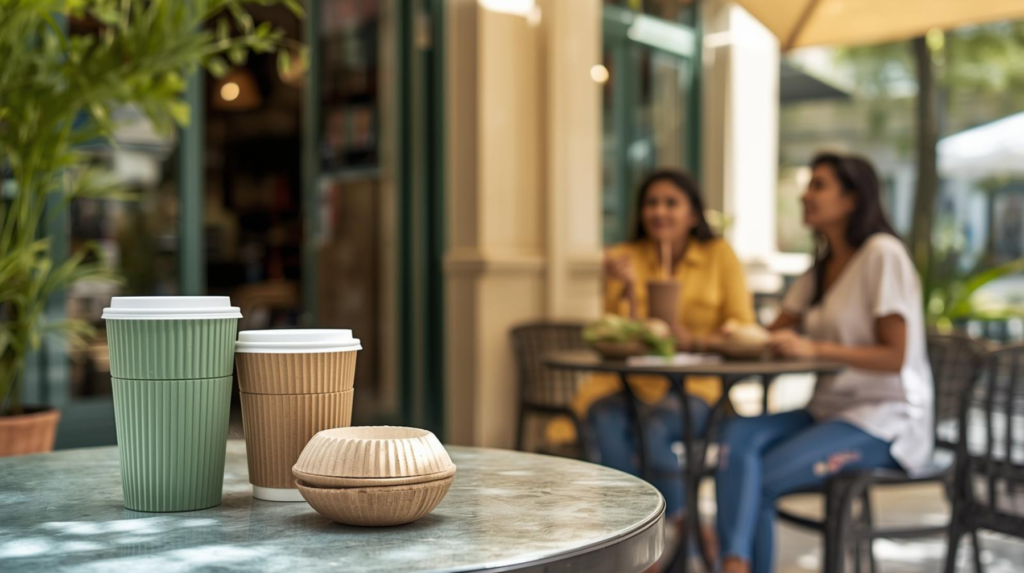
The New Business Imperative for Restaurants and Cafés
If you run a restaurant or café today, packaging is no longer a background decision. It is an active, central component of your brand and your operations. It shows up everywhere: in customer feedback, in delivery complaints, in compliance checks, and sometimes, unfortunately, in fines or wasted stock. For a long time, packaging was chosen for one simple reason, it was cheap and readily available. Conventional plastic fit that role perfectly. It stacked well, traveled easily, and nobody questioned it much. That era is definitively over.
What is replacing it isn’t just a new material, but a fundamentally different way of thinking. Finding the Best Eco-Friendly Packaging for Restaurants and Cafés now means balancing three critical factors: performance, environmental responsibility, and practical business reality. Miss one of those, and the entire solution is unsustainable in a business sense.
At K.B. Overseas, working as an eco-friendly food packaging supplier and exporter from Gujarat, India, we observe this profound shift daily across global markets. Restaurants and cafés are not asking for abstract theories. They want packaging that works perfectly during rush hours, survives the rigors of modern delivery services, and does not create future legal or environmental problems. This strategic shift is why committing to the Best Eco-Friendly Packaging for Restaurants and Cafés is no longer optional; it is a core business necessity. To explore the full product range and capabilities, please visit their website.
Defining the Best Eco-Friendly Packaging for Restaurants and Cafés
A lot of packaging is successfully marketed as “green.” However, far fewer options actually survive the realities of daily food service use. The Best Eco-Friendly Packaging for Restaurants and Cafés is not defined by labels alone. It is defined by what happens after a hot, saucy meal goes inside the container, after the lid is closed securely, and after the package travels across a busy city.
True sustainability begins with the full lifecycle analysis of the material. This includes:
- Source: Where the material comes from (renewable or finite).
- Performance: How it holds up under real-world conditions (heat, grease, transit).
- End-of-Life: Where it ultimately ends up (compost, landfill, or ocean).
If any one of those points breaks down, the entire system fails, and the packaging cannot be considered the Best Eco-Friendly Packaging for Restaurants and Cafés.
Raw Materials Matter More Than Marketing Slogans
The search for the Best Eco-Friendly Packaging for Restaurants and Cafés must begin with raw materials. Some materials are marketed as “green” simply because they are not plastic. That is no longer a sufficient standard. Restaurants and cafés need packaging made from resources that are demonstrably renewable and sustainable long-term.
- Bagasse (Sugarcane Pulp): This is where a waste product becomes a hero. Bagasse comes from sugarcane residue, the fibrous pulp left after the juice extraction process. Instead of being burned or discarded, this material is converted into high-performance bagasse food containers. This is critical for two reasons. First, it is tree-free. No forests are involved in its production. Second, it is highly renewable, as sugarcane is harvested every year. Bagasse containers handle heat well, resist grease naturally, and hold their shape during transport, making them a cornerstone of the Best Eco-Friendly Packaging for Restaurants and Cafés.
- Responsibly Sourced Paperboard: Paper cups still play a vital role in food service. Coffee, tea, cold drinks, and soup all rely on paper formats. However, for paper to be part of the Best Eco-Friendly Packaging for Restaurants and Cafés, it must be food-grade, responsibly sourced (often verified by FSC certification), and, most importantly, compatible with commercial composting systems. Without this, paper cups just become another waste problem with better branding. The material must have a certified compostable lining to offer true sustainable disposable packaging solutions.
Certifications Are Not Optional Anymore
It is easy for any eco-friendly food packaging supplier to claim that their packaging is compostable. Proving it is significantly harder. For packaging to be genuinely eco-friendly, disposal claims must be verified by a neutral third party.
Certifications from recognized international bodies like BPI (Biodegradable Products Institute) or TÜV Austria exist for a reason. They confirm that materials will break down entirely into non-toxic components under the defined conditions of industrial composting facilities. This is crucial for achieving true sustainable disposable packaging solutions.
This verification process matters immensely to your business because vague “biodegradable” claims do not protect you from regulatory non-compliance or customer distrust. Certified compostable products, however, offer a solid defense. Restaurants using verified packaging avoid future regulatory confusion and customer skepticism, solidifying their reputation for providing the Best Eco-Friendly Packaging for Restaurants and Cafés. This commitment to verified standards is why partnering with an experienced exporter like K.B. Overseas is essential.
High-Performance Sustainable Disposable Packaging Solutions
The shift to the Best Eco-Friendly Packaging for Restaurants and Cafés must be driven by performance, not just idealism. If the packaging leaks, collapses, or fails to keep food warm, it damages the customer experience and ultimately leads to food waste, negating the environmental benefit.
Why Bagasse Food Containers Offer Superior Practicality
There is a common, outdated assumption that sustainable packaging means weaker packaging. That assumption usually disappears after the first real test with high-quality bagasse food containers.
Bagasse food containers are not delicate. They are built for the demanding environment of hot, heavy meals. Think curries, rice dishes, saucy pasta, and fried items. These foods are not gentle on containers.
- Rigidity and Strength: Bagasse offers a rigidity that prevents the container from collapsing when stacked or held by a customer. This structural integrity is a major advantage over flimsy plastic or traditional paperboard options.
- Grease and Moisture Resistance: Bagasse resists moisture and oil naturally, meaning it performs better than many paperboard options without needing thick, non-compostable plastic coatings. It prevents the dreaded “soggy bottom” and helps ensure your customers receive the food as intended.
- Temperature Tolerance: Another powerful advantage of bagasse food containers is their temperature tolerance. They handle microwaves and freezers safely, which customers value highly for reheating leftovers or freezing prepared meals. This versatility makes them the Best Eco-Friendly Packaging for Restaurants and Cafés for a wide range of menu items.
The genuine bagasse food containers benefits mean that sustainable disposable packaging solutions stop being a compromise and start being a practical enhancement to your service. K.B. Overseas focuses on producing these bagasse food containers with the highest structural and safety standards.
Compostable Paper Cups Defining the Beverage Experience
Drinks are unforgiving. A leaking cup, a cup that is too hot to hold, or a cup that fails to maintain temperature instantly ruins the customer experience. High-quality compostable paper cups make a difference, not just for safety, but for customer perception and brand value.
For an item to be part of the Best Eco-Friendly Packaging for Restaurants and Cafés, it needs to work without fail.
- Thermal Protection: Compostable paper cups often come in double wall or ripple wall designs. These designs reduce the need for extra sleeves, making the cup safer to hold and improving insulation for hot beverages like lattes and teas.
- True Compostability: The key difference between a standard paper cup and a truly eco-friendly one is the lining. Compostable paper cups must use a plant-based lining, such as PLA (Polylactic Acid), instead of the traditional petroleum-based plastic (PE) lining. Without this certified compostable lining, the cup cannot break down properly in an industrial facility.
- System Synergy: When you pair certified compostable paper cups with bagasse food containers, you allow your restaurant or café to offer a complete, cohesive, and fully sustainable takeaway solution. This avoids mixing materials that confuse customers and complicate waste streams, simplifying operations and making it the Best Eco-Friendly Packaging for Restaurants and Cafés.
To view the range of certified compostable paper cups and high-quality bagasse food containers, you can view their products gallery here.
Navigating Regulation and Building Brand Value
The path to finding the Best Eco-Friendly Packaging for Restaurants and Cafés is paved with regulatory requirements and high consumer expectations. The packaging you choose is one of your most visible interactions with both the government and your clientele.
The Acceleration of Plastic Waste Regulation
Plastic waste regulation is not slowing down; it is accelerating rapidly across every major market. Extended Producer Responsibility (EPR) schemes are expanding, forcing producers (and often, indirectly, users like restaurants) to bear the financial burden of packaging disposal. Single-use bans are increasing in frequency and scope. Materials that were allowed last year may not be allowed next year.
This regulatory uncertainty creates a massive risk for businesses that hold non-compliant inventory. Imagine ordering a year’s supply of containers, only for a new wave of plastic waste regulation to render them illegal for single-use service within six months.
- Choosing certified compostable and renewable sustainable disposable packaging solutions mitigates this risk. It future-proofs your inventory, protects its value, and significantly reduces your future liability under evolving plastic waste regulation.
- This strategic decision to use the Best Eco-Friendly Packaging for Restaurants and Cafés is not merely a cost; it is a powerful form of operational risk management. Delaying usually costs significantly more than acting early.
Consumer Demand: Why Packaging is a Marketing Asset
The public’s awareness of environmental issues has never been higher, and this directly impacts buying habits. Consumer demand for eco-friendly packaging is no longer a niche concern, it is a mainstream expectation. Customers actively seek out and prefer brands that align with their values.
Surveys consistently show that a significant majority of consumers prefer brands that use sustainable disposable packaging solutions, and many are willing to pay a premium for them.
This means that choosing the Best Eco-Friendly Packaging for Restaurants and Cafés is an active marketing asset. It generates:
- Enhanced Brand Trust: Customers associate responsible materials with a business that cares about quality and ethics.
- Positive Word-of-Mouth: Sustainable choices become a point of positive differentiation in a crowded market.
Custom Printed Bagasse Packaging: Communication That Connects
Packaging is your silent sales force. Custom printed bagasse packaging ensures that your commitment to sustainability is loud and clear.
- Clarity of Message: High-quality printing on bagasse food containers and compostable paper cups allows for clear messaging, such as “Tree-Free” or “Certified Compostable.” This immediately informs the customer about the value proposition without needing a separate brochure.
- Visual Consistency: Custom branding ensures that every piece of your sustainable disposable packaging solutions, from the coffee cup lid to the clamshell container, looks professional and aligned. This consistency enhances the perception of quality and care.
Technical Expertise: Printing on bagasse can be technically complex due to its fibrous nature. The Best Eco-Friendly Packaging for Restaurants and Cafés requires an eco-friendly food packaging supplier who possesses the specialized processes and ink technology to ensure sharp, consistent branding on custom printed bagasse packaging
The Role of the Eco-Friendly Food Packaging Supplier
The material science is only half the battle. The other half is logistics, quality control, and international supply chain stability. Even the Best Eco-Friendly Packaging for Restaurants and Cafés is useless if it does not arrive on time, in the correct volume, and with consistent quality.
Why Supplier Reliability is the Ultimate Performance Metric
Restaurants and café chains run on thin margins and tight schedules. They need suppliers who understand global export logistics, not just raw materials. Delays disrupt operations. Inconsistent quality creates complaints and potential food safety issues. Poor documentation creates costly customs issues, particularly when navigating diverse plastic waste regulation internationally.
As a global exporter and eco-friendly food packaging supplier, K.B. Overseas works with clients across demanding markets like the USA, UK, Canada, Australia, and the UAE. Each region has its own specific standards, complex paperwork, and high expectations for delivery timeliness.
- Logistical Excellence: Managing this complexity requires deep experience. K.B. Overseas maintains stable, long-term logistics partnerships to ensure consistent shipping and efficient customs clearance.
- Quality Consistency: The structural integrity and performance of the bagasse food containers must be identical, whether it is batch one or batch five hundred. This consistency is essential to ensuring the bagasse food containers benefits are delivered reliably, meal after meal.
- Scalability: The ability to scale production to meet seasonal peaks or rapid growth is non-negotiable for large chains. The Best Eco-Friendly Packaging for Restaurants and Cafés comes from a supplier who can handle high volume without sacrificing quality.
By focusing on scalable, quality-driven production of certified sustainable disposable packaging solutions, K.B. Overseas helps global businesses navigate the shift away from old plastics with stability and confidence.
Strategic Planning and Sustainable Growth
The long-term value of choosing the Best Eco-Friendly Packaging for Restaurants and Cafés far outweighs the marginal upfront cost difference compared to cheap, non-compliant alternatives.
Long-Term Strategy Beats Short-Term Cost Savings
Some businesses delay switching because sustainable disposable packaging solutions appear more expensive upfront. What is often tragically missed is the greater long-term cost of delay and disruption. These costs include:
- Emergency Transitions: Rushed, last-minute sourcing when a ban hits, forcing you to pay premium prices for inferior or uncertified stock.
- Wasted Inventory: Losing the value of non-compliant stock due to new plastic waste regulation.
- Customer Backlash: The reputational damage from being seen as a laggard in sustainability, failing to meet consumer demand for eco-friendly packaging.
- Operational Stress: The inevitable disruption from supplier changes and inconsistent material quality.
The Best Eco-Friendly Packaging for Restaurants and Cafés is the one that you do not have to replace again next year. Operational stability and compliance certainty have immense, measurable business value. Businesses that move early gain competitive control, securing better supplier partnerships and enjoying the marketing advantage of being a leader.
Why Restaurants and Cafés Are Rethinking Packaging Decisions
Packaging used to be purely operational. Now, it is strategic.
- It affects compliance with plastic waste regulation.
- It affects customer trust and consumer demand for eco-friendly packaging.
- It affects delivery quality and food safety.
Restaurants and cafés that treat packaging as an integral part of their brand strategy adapt faster and face fewer surprises. Those who ignore the need for the Best Eco-Friendly Packaging for Restaurants and Cafés usually end up reacting under severe pressure and stress.
Partnering With K.B. Overseas for Sustainable Growth
K.B. Overseas focuses on manufacturing sustainable disposable packaging solutions that perform in real environments: actual service conditions, not just samples.
From high-performance bagasse food containers to certified compostable paper cups, every product is designed to balance verified sustainability with non-negotiable reliability. Operating from Gujarat, India, provides efficient access to renewable raw materials and scalable manufacturing, all while maintaining the strict export and certification standards required by international markets. K.B. Overseas does not position packaging as a trend; we treat it as indispensable infrastructure for modern food service.
Final Thoughts
Finding the Best Eco-Friendly Packaging for Restaurants and Cafés is not about choosing the most talked-about option. It is about choosing a solution that works consistently, complies reliably with plastic waste regulation, and aligns with the inevitable direction of the global food industry.
Sustainable packaging is no longer optional. It is becoming the industry default. The question is not whether to change, it is how strategically prepared your business is for what comes next.
To start aligning your strategy with a reliable, quality-focused eco-friendly food packaging supplier and secure the Best Eco-Friendly Packaging for Restaurants and Cafés, please contact their page and LinkedIn for more details.
Frequently Asked Questions (FAQs)
Q: How do you verify the sustainability of bagasse food containers?
A: We verify the sustainability of bagasse food containers through rigorous third-party certifications, such as BPI or TÜV Austria. These certifications confirm that the material will fully break down into non-toxic compost under commercial conditions, which is essential for true sustainable disposable packaging solutions.
Q: Is custom printed bagasse packaging durable for delivery?
A: Yes, custom printed bagasse packaging is highly durable. The bagasse material itself is strong, rigid, and naturally grease-resistant, making it one of the best eco-friendly packaging for restaurants and cafés for delivery. The custom printing uses specialized food-safe inks designed to adhere to the fibrous surface without compromising the container’s structural integrity.
Q: Can large recurring orders of sustainable disposable packaging solutions be managed internationally?
A: Absolutely. As an experienced eco-friendly food packaging supplier and exporter, K.B. Overseas manages complex international logistics, compliance documentation (including specific plastic waste regulation requirements for different regions), and volume consistency for large recurring orders across various global markets.
Q: Why should a restaurant choose compostable paper cups over cheaper recyclable plastic cups?
A: Compostable paper cups are often preferred because they eliminate petrochemical plastics entirely and are designed to break down in industrial composting facilities. Many recyclable plastic cups still end up in landfills due to low local recycling rates or contamination. Choosing compostable options demonstrates a stronger commitment to meeting consumer demand for eco-friendly packaging and aligning with stricter regulations.
Q: What are the primary bagasse food containers benefits over paperboard containers?
A: The main bagasse food containers benefits are superior heat and moisture resistance and structural rigidity. Bagasse handles hot food and saucy dishes much better than standard paperboard, maintaining its shape and preventing leakage without requiring heavy plastic coatings.
Q: How does plastic waste regulation specifically impact my restaurant’s choice of packaging?
A: Plastic waste regulation typically bans specific single-use items (like PS foam, certain cutlery, and unlined cups) and introduces EPR fees on non-renewable materials. By transitioning to certified bagasse food containers and compostable paper cups, your restaurant avoids the risk of fines, prevents wasted non-compliant inventory, and is better positioned for future regulatory changes.
Q: Is the switch to the best eco-friendly packaging for restaurants and cafés cost-prohibitive?
A: While the upfront material cost of the Best Eco-Friendly Packaging for Restaurants and Cafés may be marginally higher than the cheapest plastics, the long-term cost is often lower. This is because you save on potential regulatory fines, reduce waste disposal fees, and gain significant value from enhanced brand reputation and increased consumer demand for eco-friendly packaging.
Q: What advantage does an India-based eco-friendly food packaging supplier like K.B. Overseas offer?
A: An India-based eco-friendly food packaging supplier like K.B. Overseas offers efficient manufacturing scale, direct access to abundant, renewable raw materials like sugarcane for bagasse food containers, and competitive global pricing. This is achieved while rigorously adhering to the high-quality and certification standards (like food-grade safety and compostability verification) required by international markets.
Q: How can I educate my customers about the proper disposal of compostable paper cups and bagasse food containers?
A: You can use clear, simple messaging on your custom printed bagasse packaging and your menus. Use concise phrases like “Compost Me” or “Tree-Free Container.” Providing clear signage near bins or simple instructions on your takeout website helps customers correctly dispose of your sustainable disposable packaging solutions.
Q: Are bagasse food containers safe for hot soups and liquid-heavy dishes?
A: High-quality bagasse food containers are remarkably water-resistant and perform well with hot soups and curries for the typical takeout and delivery duration. They are often molded deep and designed with securely fitting lids. While they are not meant for indefinite long-term liquid storage, their performance is far superior to most conventional paperboard options.
Q: What is the main difference in performance between bagasse food containers and standard paper containers for hot food service?
A: Bagasse food containers offer superior heat tolerance and natural grease resistance compared to standard paper. While paper often requires a plastic (PE) lining to handle moisture and oil, which compromises compostability, bagasse food containers are inherently strong due to their natural sugarcane fibers. This means the Best Eco-Friendly Packaging for Restaurants and Cafés is microwave-safe, resists the “soggy bottom” effect, and maintains structural integrity longer with hot, liquid-heavy meals, all while being fully compostable.
Q: How do Extended Producer Responsibility (EPR) schemes under plastic waste regulation affect my annual packaging costs?
A: Plastic waste regulation is increasingly using EPR schemes, which financially shift the full cost of collecting, sorting, and recycling packaging waste from local taxpayers to the businesses (producers/importers) who place the packaging on the market. These costs are often eco-modulated, meaning they penalize hard-to-recycle materials (like composite plastics) and incentivize easily recyclable or compostable options. By choosing certified sustainable disposable packaging solutions like compostable paper cups and bagasse food containers, you can significantly lower your EPR fees and future financial liability.
Q: Is it worth the investment for a small café to use custom printed bagasse packaging?
A: Yes, investing in custom printed bagasse packaging is a powerful marketing strategy even for small cafés. Packaging is your most frequent physical touchpoint with the customer. High-quality custom printed bagasse packaging elevates brand perception, clearly communicates your commitment to sustainability, and helps you meet the rising consumer demand for eco-friendly packaging. This investment in brand identity often leads to higher customer retention and willingness to pay a premium, which outweighs the marginal cost difference.
Q: Are bagasse food containers sourced from K.B. Overseas certified to be free from harmful chemicals like PFAS?
A: A core commitment of K.B. Overseas as an eco-friendly food packaging supplier is to provide the Best Eco-Friendly Packaging for Restaurants and Cafés that is safe and non-toxic. Our bagasse food containers are typically processed using sustainable methods and are designed to be free from per- and polyfluoroalkyl substances (PFAS), which are often used in older moisture-resistant packaging. We ensure compliance with international food contact safety standards to provide genuinely clean sustainable disposable packaging solutions.
Q: What is the risk of using non-certified “biodegradable” packaging instead of certified compostable paper cups?
A: The primary risk is greenwashing and non-compliance. Non-certified “biodegradable” products often require specific, lengthy conditions to break down and may leave behind toxic residues or microplastics. This makes them unsuitable for commercial composting facilities and highly likely to be non-compliant under emerging plastic waste regulation. Certified compostable paper cups (like those offered by K.B. Overseas) are verified by third parties (e.g., BPI) to break down cleanly within a specific timeframe, offering your business legal certainty and genuine environmental integrity.